
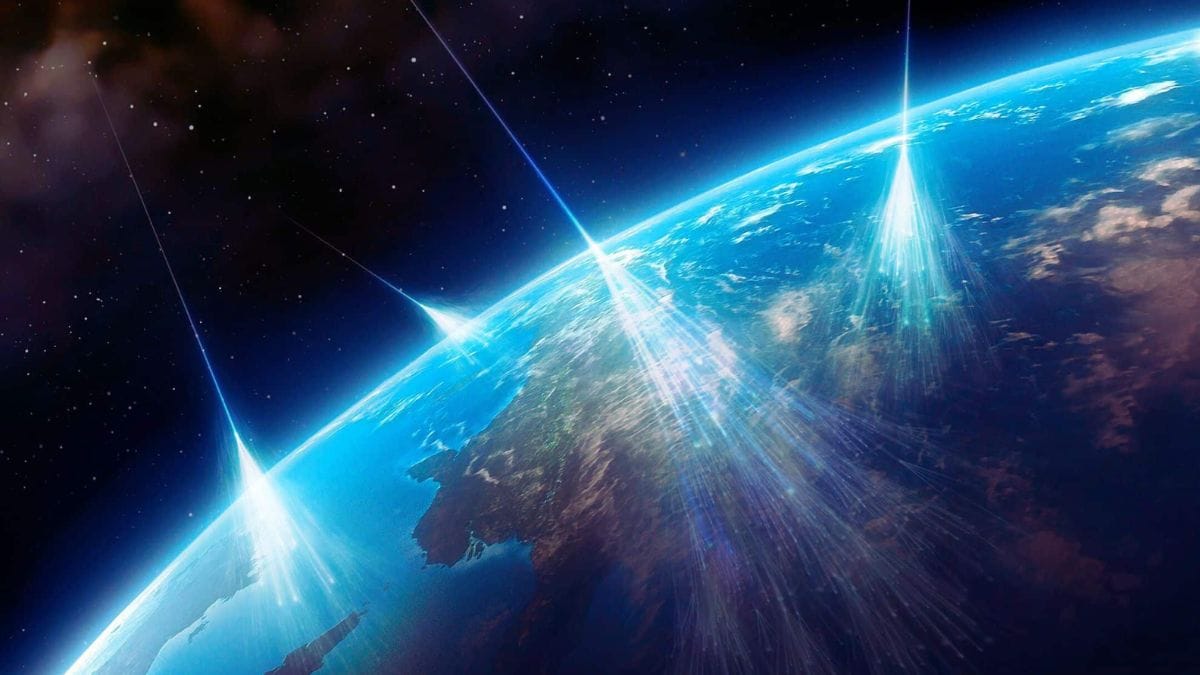
The seek for alien life historically focuses on planets within the “Goldilocks zone” — the orbital band the place floor water can exist. However new analysis suggests life would possibly thrive removed from starlight in a so-called “radiolytic liveable zone,” the place penetrating cosmic rays break buried water molecules (a course of referred to as radiolysis) into hydrogen, oxygen and energy-rich electrons. Simulations of icy worlds like Mars, Europa and Saturn’s moon Enceladus present cosmic rays can attain subsurface water. Researchers counsel these electrons may gasoline microbes in hidden reservoirs, successfully creating underground oases of life.
Radiation as a Energy Supply
In line with the new study, cosmic rays are fast-moving particles (electrons, protons or nuclei) blasted out by supernovas and distant stars. On Earth, most are stopped by our magnetic subject and thick ambiance. However Mars and the icy moons (which lack such shields) get hit immediately; their skinny air or vacuum permits rays to penetrate deep into ice and rock. When these particles strike water or ice, they set off radiolysis – shattering molecules and liberating hydrogen, oxygen and electrons. Some Earth microbes already exploit this: for instance, a bacterium 2.8 km underground in a gold mine lives totally on hydrogen produced by radioactive decay.
Increasing the Seek for Life
Dubbed the “Radiolytic Liveable Zone,” this hidden-energy band lies beneath ice or rock the place cosmic rays can maintain life. Simulations present Saturn’s icy moon Enceladus has the best radiolytic potential, adopted by Mars after which Jupiter’s moon Europa. NASA’s upcoming Europa Clipper mission and telescopes like ALMA will probe these frozen worlds for chemical indicators of life. Much more intriguingly, cosmic-ray impacts can immediately create advanced natural molecules (for instance, amino-acid precursors) in ice. As a result of cosmic rays pervade the galaxy, even a rogue planet adrift in house could be bathed in intense radiation.
As Dimitra Atri, an astrophysicist and co-author of the brand new examine places it, “life would possibly be capable of survive in additional locations than we ever imagined”, suggesting hidden biospheres may exist in lots of chilly, darkish niches.